Core needs: what really drives you

Two people say the same sentence: “I need more money.” For one of them it means finally no longer being afraid of the next bill. For the other it means finally being seen for what she achieves. The wish is the same. The need behind it is a completely different one.
That is what this article is about: the core needs behind your wishes, goals and values. Why we so often mix them up. And why your life gets easier once you know your own.
What core needs are
Core needs are what every person needs in order to feel well and alive. Not things, but inner states: stability, significance, closeness, development. Every person has all of them. What sets us apart is the weighting. For one person certainty matters most, for another variety, for the next a deep connection with a few people.
A simple distinction helps:
- A value tells you what matters to you, for example success, freedom or family.
- A need tells you why it matters. Behind success there may be a need for certainty, for significance or for growth.
- A strategy tells you how you meet the need: with the next career step, a savings plan, a journey.
Values and strategies can change. The needs underneath stay.
You may know the hierarchy of needs pyramid that is usually attributed to Abraham Maslow. The pyramid itself, however, does not come from him, and needs do not work step by step. They act at the same time. In his research the psychologist Klaus Grawe stressed that psychological core needs are of equal weight and that we are well when they are in harmony with each other.
The eight core needs
A model that has proven useful in coaching is the Six Human Needs, made known by Tony Robbins and the family therapist Cloé Madanes. In the values assessment they are refined into eight core needs: uncertainty and variety stand apart, and so do belonging and connection. A coaching model is not an exact science. As a map of your own needs, though, it works well.
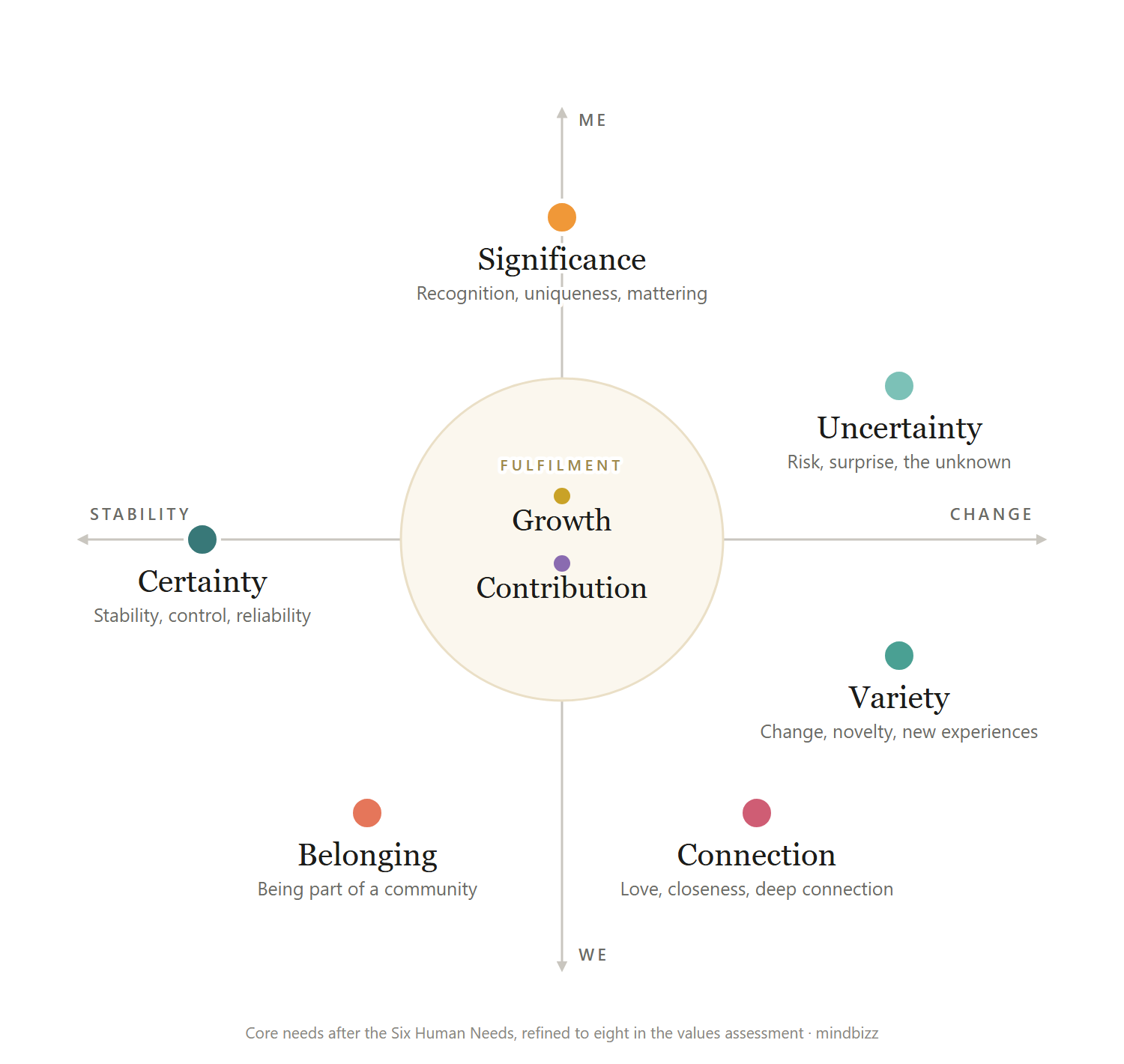
Certainty: Stability, control, reliability
You want to know where you stand. Certainty gives you something to hold on to: a reliable income, people you can count on, plans that work out.
Uncertainty: Risk, surprise, the unknown
It sounds paradoxical, but it is deeply human: we also need the thrill of an open outcome. Without a little uncertainty, life becomes narrow.
Variety: Change, novelty, new experiences
New places, people, topics. Variety keeps you alive and curious. Without it, even a good life starts to feel like a repetition at some point.
Significance: Recognition, uniqueness, mattering
You want to be seen and to feel that it makes a difference that you exist. Significance can come from achievement, from responsibility or from what you give to others.
Belonging: Being part of a community
Family, team, circle of friends, a movement. Belonging means: I am part of this, just as I am.
Connection: Love, closeness, deep connection
Unlike belonging, this is not about the group but about a real encounter between two people: truly seeing and being truly seen.
Growth: Learning, development, maturing
Being a little further today than yesterday, as a person, in your skills, in your understanding. Growth can never be completed, and that is exactly where its power lies.
Contribution: Giving, serving, going beyond yourself
Doing something that benefits others. For many people, meaning only arises here: when what they do reaches beyond their own life.
Stability and change, me and we
Some needs pull in opposite directions. Certainty wants stability, uncertainty and variety want change. Significance puts you as an individual at the centre, belonging and connection put the togetherness there. This tension is not a flaw, it belongs to it. Whoever lives only certainty grows rigid. Whoever only seeks variety finds nothing to hold on to.
Growth and contribution sit in the middle. According to the Six Human Needs, we always meet the other needs somehow, in healthy or unhealthy ways. Deep fulfilment, however, only comes when we grow and contribute something.
The me and we may sound familiar: the developmental levels of Spiral Dynamics also alternate between a focus on the individual and a focus on the community.
Why we so often misread our needs
The tricky thing about needs: we rarely see them directly. What we see are wishes, goals and habits, the tip of the iceberg. The need underneath usually stays invisible.
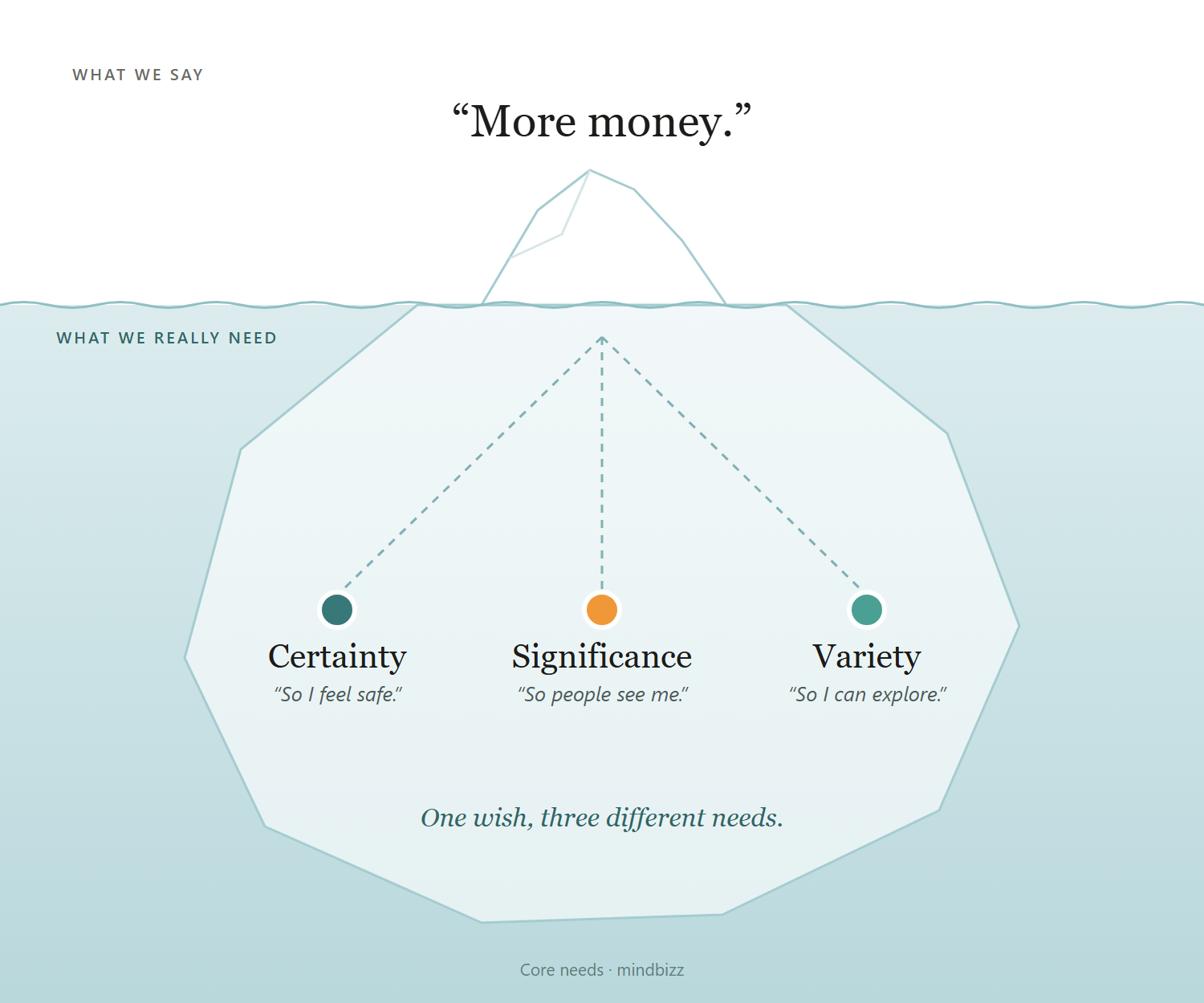
That is why we often get it wrong. A few examples:
- The promotion. You think it is about success. But perhaps it is about significance: finally being seen. Or about growth: you want to learn something new. Both can also be met in quite different ways.
- The full calendar. You think of yourself as someone who needs variety. But perhaps you only keep moving because silence feels uncomfortable, and what you are actually missing is stability.
- Control over everything. What looks like a strong need for certainty is sometimes a call for connection: if you cannot rely on anyone, you have to keep everything under control yourself.
- Lots of contacts. Having many people around you meets the need for belonging. The need for real closeness can still go hungry.
On top of that, every need can be met in healthy or unhealthy ways. You can get certainty through trust, but also through a compulsion to control. You can get significance through volunteering, but also through an argument you absolutely have to win. If you do not know your needs, you easily end up with strategies that help briefly and do harm in the long run.
Why this matters for your life and your development
When you know what you really need, you make different decisions. You stop chasing the substitute and take care of the original.
- You act in harmony with yourself. Goals that fit your needs give you energy instead of costing it.
- You understand your inner conflicts. When certainty and variety pull against each other, that is not a character flaw but a tension you can shape consciously.
- You understand others better. Someone who decides differently from you often simply has other needs in the foreground. That takes the heat out of many conversations, at work, in the family and in your relationship.
And it opens your eyes to growth and contribution. If you meet your core needs in healthy ways, you have strength left for your own development and for what you can give to others.
A small exercise: ask “what for?” three times
Take a wish that is on your mind right now: a new job, a move, more time, a particular goal. Ask yourself: what do I want this for? And ask again about the answer: what for? By the third time at the latest, you will usually land on a core need.
An example: “I want a new job.” What for? “So I earn more.” What for? “So I am not constantly worried about the rent.” This is certainty speaking. For another person the same path may end with “So my work finally makes a difference”, and then it is contribution speaking.
After that, it is worth asking: are there other ways to meet this need? Often they are easier than the original wish suggested.
Find out which needs drive you
Behind every value there is a core need. That is exactly what the values assessment evaluates: each of the 412 values is assigned to one or more of the eight core needs. You choose your eight most important values, compare them in 28 decisions, and at the end you see not only your top 8 but also the three core needs that are strongest for you. Plus your developmental levels according to Spiral Dynamics.
You can find out more about how the assessment works on the page Personal Values Assessment Test. What lies behind the developmental levels is explained in the article Spiral Dynamics explained simply.
