Spiral Dynamics explained simply
Why does one person value security above everything, while another mainly wants to be free? Why does one team argue about rules and another about purpose? Spiral Dynamics is a model that explains differences like these. It describes how people think, what matters to them and how that changes over the course of a life.
Maybe you came here from the values assessment and saw colours like orange or blue in your result. Here you will find out what is behind them. No prior knowledge needed.
What are developmental levels?
Spiral Dynamics assumes that we do not all see the world in the same way. Each developmental level is like a pair of glasses: a particular view of what matters in life, what is right and how to solve problems. The model describes eight such levels. Each has a colour to make it easier to remember. The colours are just names, they do not rate anything.
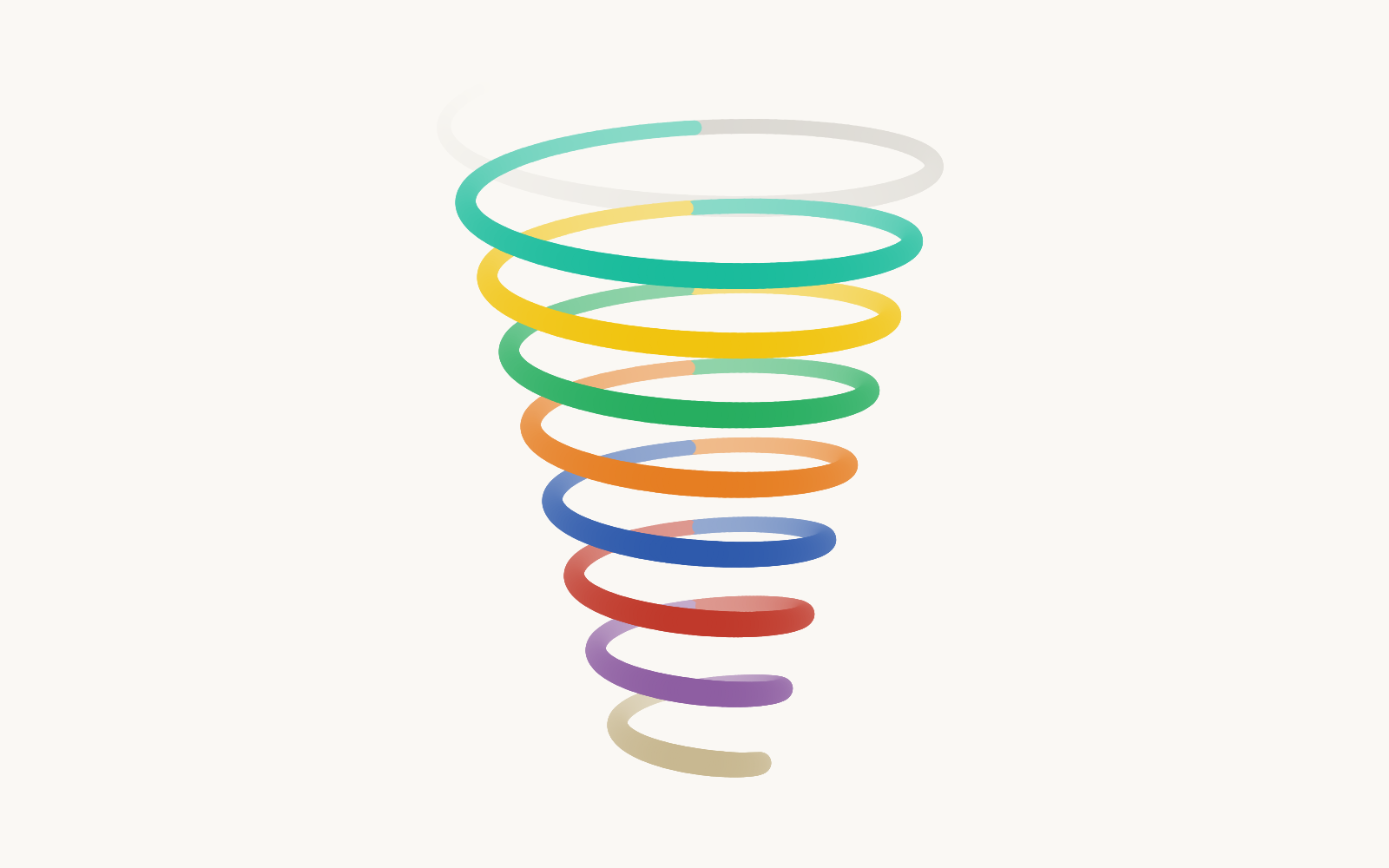
The levels build on each other. A new level emerges when life conditions change and the old answers no longer work. Someone fighting to survive needs food and shelter first. Once that is secured, belonging becomes important, later order, then success and so on. The image for this is a spiral that winds upwards and grows wider as it goes. With every turn, thinking becomes broader. What came before is not lost, it becomes part of the new.
The eight levels at a glance
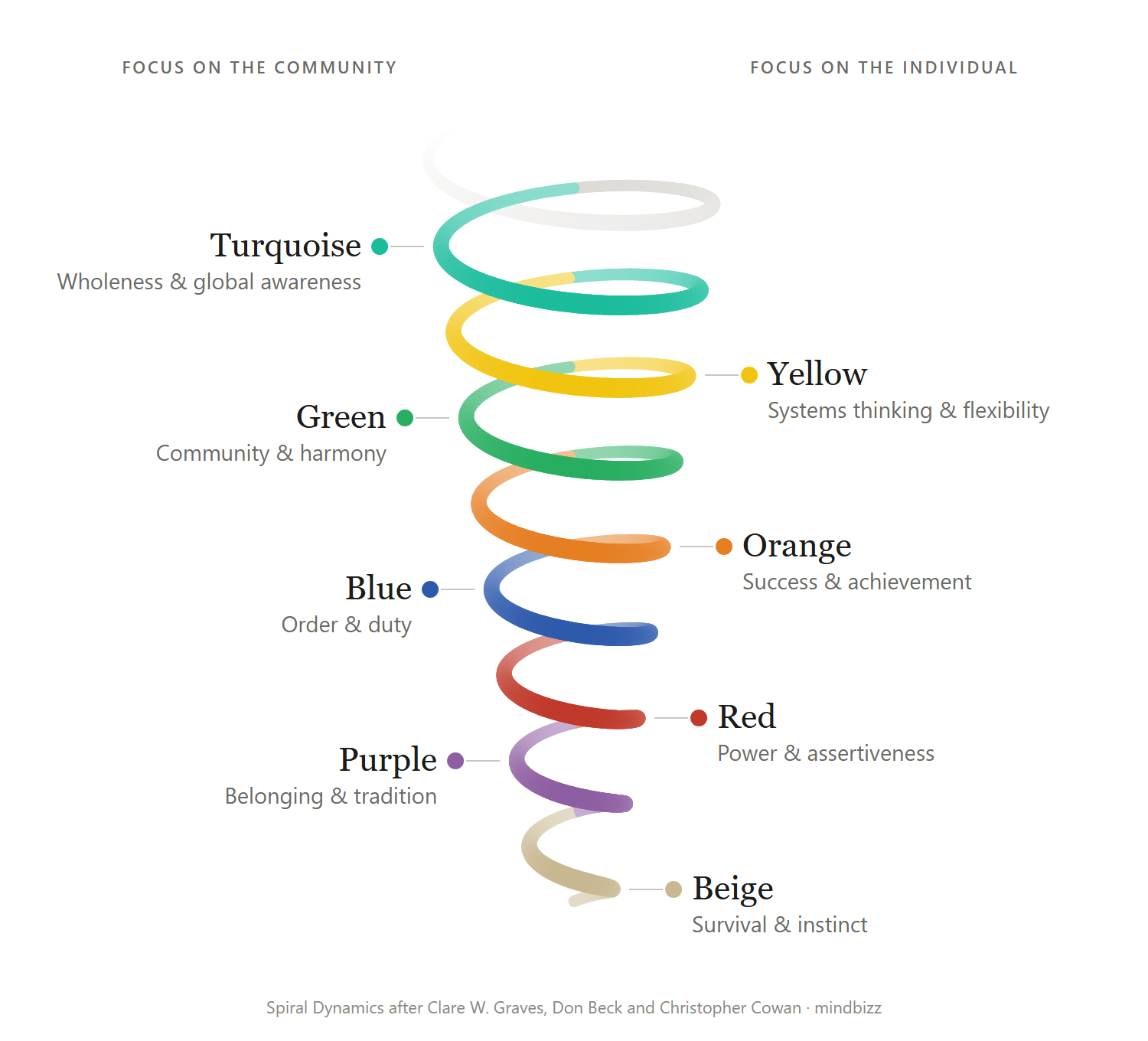
Beige: Survival & instinct
The first level is about pure survival: food, warmth, shelter, sleep. We see it in newborns and in people in acute need. There is no planning here, only reacting.
Purple: Belonging & tradition
Safety comes from the group: family, clan, tribe. Rituals, customs and loyalty give support in a world that seems mysterious and unpredictable. Today, purple shows up in family traditions, in small lucky charms and in the deep feeling of belonging somewhere.
Red: Power & assertiveness
Now the self steps forward and wants to stand its ground. Red is powerful, spontaneous and bold. It wants what it wants, and it wants it now. We know this from toddlers in their defiant phase, from hero stories and from anyone who pushes through against resistance.
Blue: Order & duty
Chaos is followed by order. There is a higher truth, clear rules, right and wrong. Whoever sticks to them and does their duty will be rewarded, if not today, then later. Blue lives in institutions, religions, public administration and in any organisation with a clear rulebook.
Orange: Success & achievement
Now what counts is what works. Orange thinks in goals, strategies and results, trusts science and its own abilities and wants to get ahead. Entrepreneurship, competition and technological progress are typically orange.
Green: Community & harmony
Success alone does not make you happy, says green. What matters are people, feelings, equality and getting along well. Decisions should be carried by everyone. Green shows up in teams that rely on consensus, in social engagement and in the commitment to the environment and diversity.
Yellow: Systems thinking & flexibility
Yellow sees connections. Instead of believing that one view is the only right one, yellow asks: what does this situation need right now? Sometimes a clear rule is best, sometimes freedom, sometimes community. Knowledge, competence and independence count for more than status.
Turquoise: Wholeness & global awareness
Turquoise experiences the world as one connected whole. The individual, humanity and nature belong together. The focus is on the wellbeing of the whole, on purpose and on a deep sense of connection across all boundaries.
Me and we: the rhythm of the spiral
If you look closely, you will spot a pattern: the levels alternate. Beige, red, orange and yellow put the individual first: your own survival, your own strength, your own success, your own freedom. Purple, blue, green and turquoise put the community first: the family, order, the group, the bigger picture. That is why the graphic shows the levels of the individual on the right and the levels of the community on the left. The colours show it too: the levels of the individual are warm, those of the community are cool.
There is something else that stands out. The first six levels usually consider their own view to be the only right one. With yellow, this changes: yellow and turquoise can understand and value all the other perspectives, because each of them fits certain life conditions. In the model, this step counts as an especially big one. And the spiral does not end with turquoise. It stays open at the top, just as the graphic suggests.
Where the model comes from
The foundation was laid by the American psychologist Clare W. Graves (1914 to 1986). As a professor at Union College in New York State, he set out in the 1950s to answer a seemingly simple question: what makes a psychologically mature, healthy adult? He asked his students to write down their answers and analysed them over many years. He noticed that there is not one answer but several, and that they follow each other in a recognisable order. From this he developed his theory of developmental levels.
Don Beck and Christopher Cowan got to know Graves in the 1970s, worked with him and continued his research after his death. In 1996 they published the book Spiral Dynamics, which gave the model its current name. The colours still used for the levels today also come from them. Since then, Spiral Dynamics has been used in companies, in consulting and coaching and even in politics to understand why people think and act so differently.
Why this matters for your values
Values are what matters to you. And what matters to you is closely linked to the glasses through which you currently see the world. If you rate order and a sense of duty highly, you often think from blue. Success and performance belong to orange. Harmony, community and sustainability carry a lot of green. Some values fit several levels: freedom, for example, is found in red, orange and yellow.
This is exactly how the values assessment works. Each of the 412 values is assigned to one or more levels. Your eight most important values create a profile, and your top three count double. Your result shows the two levels that are strongest for you. Hardly anyone thinks from one single level. Usually there is a centre of gravity and one or two levels next to it. That is not a contradiction but completely normal, because development does not happen all at once.
Knowing your levels helps you in three ways:
- You understand yourself better. You see where your values come from and why some things mean so much to you.
- You recognise inner tensions. If success and community matter equally to you, orange and green pull in different directions. Seeing this makes decisions easier.
- You understand other people. Someone who thinks from a different level is not simply wrong, they are looking through different glasses. That takes the heat out of many conversations, at work, in the family and in your relationship.
What Spiral Dynamics is not
Spiral Dynamics is not a ranking of people. A higher level does not make anyone a better person, it only describes a more complex way of thinking. Every level has healthy and unhealthy sides, and each one is the right answer to certain life conditions. In a real crisis, red is often exactly right, a hospital needs blue, and without orange there would be no progress.
The model is also a map, not an exact measurement. Your result in the values assessment is a snapshot too. When your life changes, your values often change as well, and with them your profile. That is why it is worth repeating the assessment from time to time.
Find out where you stand right now
Which levels shape you at the moment? In the values assessment, you choose your eight most important values from 412 and compare them in 28 decisions. At the end you see your top 8, your two strongest developmental levels and the core needs behind your values. If you like, you then get one impulse a day by email for seven days, built on exactly your result.
You can find out more about how the assessment works on the page Personal Values Assessment Test.
